Showing posts with label Chris Schwarz. Show all posts

Monday, May 12, 2014

Hand Saws, the Saws you Need + One+ another

  Once again Chris Schwarz says it all, clearly and briefly.  Recently Chris's blog entry "the saws you need" arrived in my in box.

christopher.php

  by Chris Schwarz.

   Chris did miss one saw that I decided needed.


24 inch Bow Saw
still in the wrapper.


   This is why I need the bow saw. Over the last while I have collected a bunch of branches from local trees and am going to cut them up, seal the ends and let them dry for a season or two.

  My plan is to turn spindles and other small lathe projects from this wood.  I thought about dragging the branches into my shop and cutting them on the band saw,  too much trouble.  Then I thought about buying a big mean blade for my reciprocal saw, but that meant long extension cords and having to haul a WorkMate or something about too. My solution, a bow saw. It is quiet, not too aggressive, safe,  ultra portable and not too expensive.   

  In that pile of wood I have Black Locust, White Cedar, Soft Maple, Poplar and Pussy Willow.  None of the wood is exotic. but it was free.  There will be lots of wood chips and hours of shop pleasure.

  And one saw that I have that I really like and Chris has decided against is a rip saw.  My rip saw is outstanding. 


 It will cut dry wood almost a quickly as my band saw.  Since I built my saw bench I have used the rip saw regularly for any type  of job that needs one or two cuts.  

My saw bench, just build one, it comes in sooooooooo handy.

cheers, ianw


Monday, December 3, 2012

Rules for Workbenches

   I search all over the internet for information on topics that attract my attention. Several times in the past I have written about work benches, recently Chris Schwarz wrote an extended article on the characteristics of a really good work bench.  It would be nice to think that I am smarter and more articulate than Mr. Schwarz, but that would be delusional fantasy, so here is the link to a very good article on what your bench should do for you.


 featuredImage

   I have built four work benches in my life and assumed ownership of two others.  Those experiences have shown me the things that I would like to see in a bench, when I build another one, someday.  The bench is a tool with which you work in your shop and so like any tool must be attuned to your needs; a carvers bench is going to be different than a furniture makers bench and a shop like mine when I do a bit of everything means the bench is a compromise.  Just remember that a compromise means that you have given up one thing to have another thing work, sort of.

  I have a bench against the wall and a large heavy wheeled work station (3x3) with shelves underneath.  Both benches get serious work, to add to that I have a KREG Klamp Table.

Kreg KKS2000 Klamp Table w/ Steel Stand Combo
   The Klamp table is a very useful assembly surface for all types of small project.  I also have a WorkMate, which has seen years of heavy on site work. 

Black & Decker, Workmate® Project Center WM225

   I may have been one of the best investments based on hours used and miles traveled. 

   Regardless of the bench on which you work care, time and effort are still the most important ingredients in success. 

Saturday, November 3, 2012

How and When to Sand Wood


Once again I have turned to a real expert, not only in wood working but also a fine and articulate writer to share his ideas with you this time about sanding.  He raises another point with which I agree, sanding is not evil and a wood worker that sands is not by definition a poor craftsman.


Mr Schwarz writes:

I’m always bemused by woodworkers who boast that they never use sandpaper.
I usually say something to them such as: “Then I guess you don’t like old-school technology.”
When they look confused, I add: “Egyptians used sandstone to abrade wood flat. Sanding is older technology than planing, which is a Greek or Roman invention.”
As far as I know there hasn’t been a definitive history written about abrasives. And please don’t ask me to write it – I have enough to do on this earth already. So if you need a good idea for a gritty bestseller….
The problem with abrasives is how they are abused in this modern day. Abrasives have almost always been some part of the finishing process, but the key word in that sentence is “part.” Today, most modern shops start with abrasives and end with abrasives. And that’s when they become the lung-clogging, vibrating misery known as power sanding.
So let’s take a close look at a more balanced approach that was practiced in England during the 19th and 20th centuries. It’s explained here by Charles H. Hayward in the book “The ABC of Woodwork.”
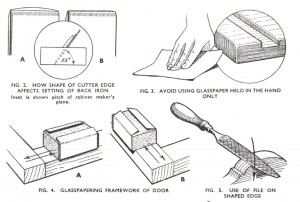
“Cleaning up a panel, table top, or whatever it may be is a fairly straightforward job. The smoothing plane cutter is sharpened to as straight an edge as possible, and the plane is set fine with the back iron as close as possible. It is assumed that the wood is already true and requires only to be skimmed to remove marks or tears made by the trying or panel plane. The entire surface is gone over with the grain. In most woods, the tears will come out, though, admittedly, there are difficult woods. So much depends on the plane and the way it is set. The cabinet maker’s smoothing plane has a high pitch in which the action approaches that of scraping rather than cutting, and if this ha the back iron set fine there are only a few woods which cannot be planed. (Remember on this score that the straighter the edge the more closely the back iron can be set.)
“In any case, however, the scraper must foll ow for all hardwoods. It is not only that it will remove any tears that may be left, but it will take out all marks left by the plane. This is a point that is easily overlooked. Then again, in some difficult woods the grain runs in streaks about 1/4 in. or 1/2 in. wide, and it is impossible to plane one with the grain without tearing up those adjoining. The scraper can be bent and used on a comparatively narrow area of the wood.
“Glasspapering follows, and a flat rubber (usually of cork) is essential. The purpose of glasspapering is only partly to smooth the surface; it has for its second object that of getting rid of marks left by the scraper. This cannot be done when the glasspaper is merely held in the hand. The pressure is uneven and is not great enough. Furthermore, all sharp edges and corners are liable to be dubbed over, giving a dull, unspirited appearance to the work.”
To summarize: Plane until you cannot improve the surface. Scrape until you cannot improve the surface. Sand until you cannot improve the surface. Finish.
This is the way I’ve worked for many years. I buy a box of #220-grit Abranet every couple years, and that covers all my sanding needs.
And one last detail: Hand sanding is a hand process requiring great skill to execute – especially when it comes to contoured surfaces. So don’t hide your sandpaper when your breeches-wearing hand-tool buddies come over for a beer.
— Christopher Schwarz
If you want to learn a lot more about handplanes, check out my book “Handplane Essentials,” a huge tome on handplane work that encompasses much of my writing on these tools for the last decade. Click here for details.
You can also read many other interesting blog postings by Mr. Schwarz at  his blog
to order sand paper on-line: thetoolstore.ca

Thursday, January 19, 2012

The Anarchist's Tool Chest


                                                                                 Last summer I bought a copy of Christopher Schwarz's book the Anarchist's Tool Chest.  Last August in fact, and I read it in three days.  Since that time I have been trying to write a clever and worthy review of this book, filled with pithy quotes and trenchant examples, clearly that is not going to happen.  So here is a not so clever but just as sincere a review of Mr. Schwarz's book.

   Christopher Schwarz is a very fine writer with a flowing conversational prose and an excellent sense of organization and style.  The information imparted is done so clearly and with objectivity.  There are many tips and ideas within the book and I have to think even the most experienced wood worker would benefit from Mr. Schwarz's insights.

   For me the real heart of the book was the author's dedication to superior quality work and what impressed me the most was his sympathy with the professional woodworking class.  I felt he placed the blame for poor quality work clearly at the feet the of consumer who demands cheap products and labour and thereby forcing production quality down.  I agree with Mr. Schwarz, wood workers would rather do fine work in real wood but they have to make a living and compete with products made from sheet stock and sold to people that don't know or care. So crafts people are unable to do their best work because they are limited by time and costs.


  If craftsmanship is to survive this down turn in consumer taste then the amateur and hobby woodworker is the one that is going to have to build for the love of the work and hope that in time their efforts will be understood and recognized.

  Having read "The Anarchist's Tool Chest" I have changed my approach in the work shop in some ways as well.  I do not use sheet stock to build any longer.  I use face frame construction to build things like book case and doors now.  It takes longer but result is much better, both more attractive and just as sturdy.