Showing posts with label freud thin kerf blade. Show all posts

Friday, June 21, 2019

Trellis for a Rose


  Wood and glue, two part epoxy glues to everything.  The plastic handle broke, after ten years which is okay and now its fixed.


  I actually set out today to build a heavy duty trellis for the rose bush seem below.   Last year I made a trellis/frame to try and control this rose bush, my effort failed.   This old 'wild' rose was then cut down to six inches from the ground as we try again to bring it under control. 
it is vigorous and colourful so we want to keep it,
just not have it take over the whole garden.

  My plan is to build a square frame to enclose the bulk of the bush.  Since it is going to be in the weather I assembled the frame with pocket holes and then filled the holes with plugs so the screws will take longer to rust .
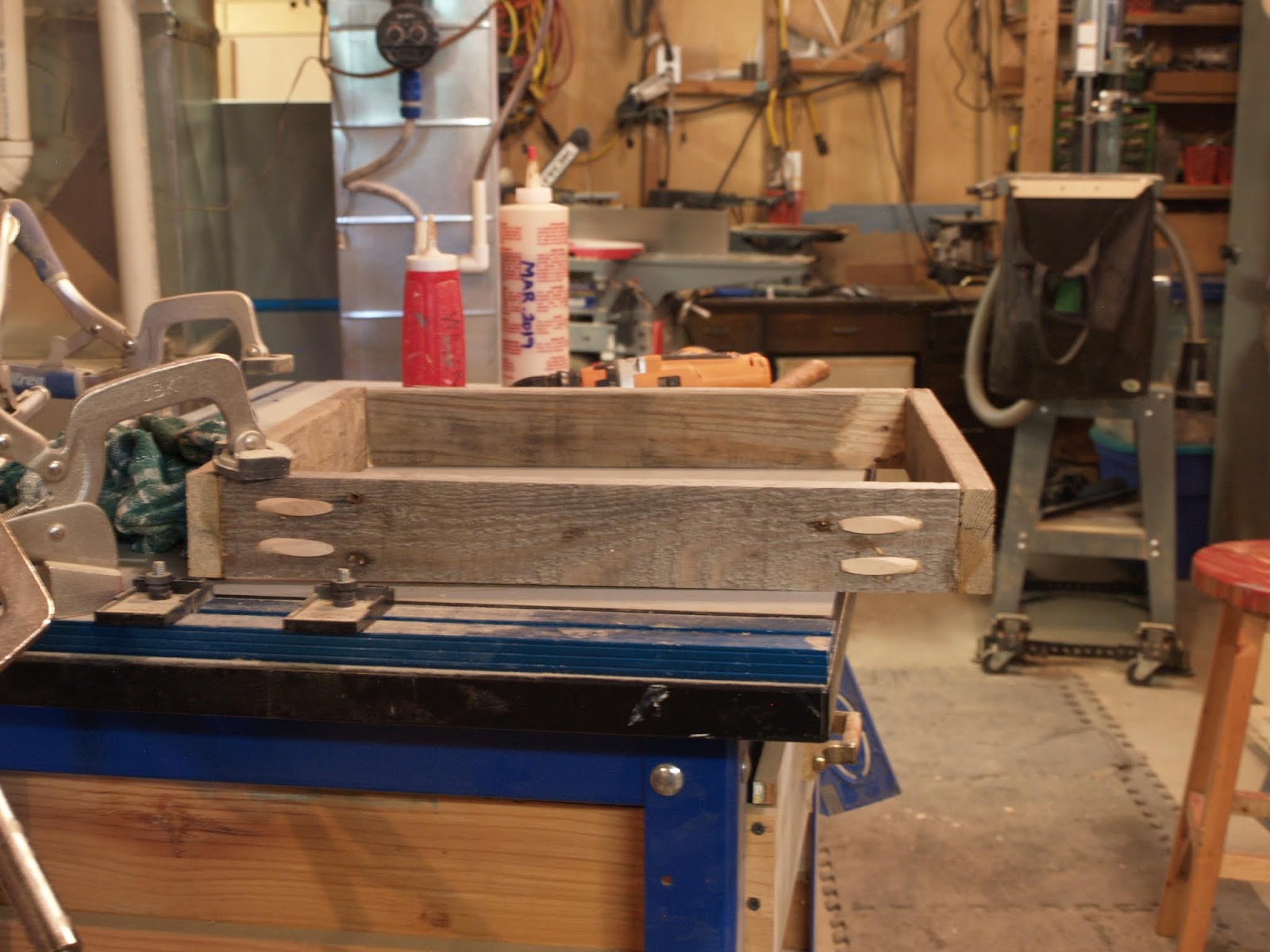
KREG -1.25 inch screws and paint grade plugs 
  Assembling a frame like this is done most easily with KREG right angle clamps.

frame completed and stained green


   I have a few pieces of rough framing timber that I am using to make legs and the bulk of the trellis frame.


 The frame is 1 1/2 wood square lumber and
 the rope threaded though is hemp.

  The trellis is held together mostly with Miller Dowels. I like using these dowels anywhere that steel fasteners would rust and I've used them assembling my work surfaces to protect saw and plane blades from mishap.

  In the process I chose to remove and replace the blades in my table saw and sliding mitre saw.  As a rule I have both blades sharpen every year or so depending on how heavily I have worked them.  Quality blades pay for themselves because they can be sharpened 4, 5 or 6 times and perform well before needing replacement.

  Once the stain is dry I can put the whole thing together in the garden and see if it controls the rose this season.

cheers, ianw


Thursday, April 4, 2019

Table Top Ready for Varnish


  Before I get to the table top I will share some of the distractions that are ongoing.

  I re glued and  screwed the music stand I made a while ago (September 19th 2016)  It was a dark and windy evening on Wednesday and my music stand blew out of my hand and across the parking lot, breaking which is why it needed to be repaired 


  I had to repair a push stick featuring a really nice handle from a jack plane, that fell on the floor and got stepped on. Needed to be fixed.


  And worth the trouble since it is very nice for working on my jointer.

  Also, today.....I took my first bicycle ride of the season.  I collected my new bike at Brant Cycle and road it home.  That was a bit of an exercise for early in the season, it was only 2 degrees about freezing when I set off for home.  An hour and twenty minutes of great riding and a chilly face. (that's where I was this morning David)
Giant LAFree E-Bike
  The e-bike lets a fat sixty-one year old man ride like he is a teenager.  I road 35ish KM today in the cold and didn't even care. I love the bike it, it is comfortable, quick as I want and it was reasonably priced. WOW.

  The other wood working project began with a need, of sorts. 


  Working on pallet wood often has me begin the sanding process with my 4 1/2 inch grinder and sanding disks.  So I have a grinder, various disks, an arbour tech cutting disk, several wrenches and other stuff.  I finally decided that these various things were drifting and needed a proper home.


  This is to be a storage box, all it needs to do is keep the grinder and its friends together when on the shelf, so I gathered up materials from the bins.

  So the bottom of the box is:


a pocket hole project.  I love my KREG jig.  It made two pieces of plywood destined for the fire place into something useful. 

  When I put the ends on the box I used pocket holes too. And for right angle assembly there is no substitute for the KREG Right Angle Clamp. 


  For the sides I got even more thrifty.  I have a couple of old pieces of Masonite, that were sink cut outs.  The pieces are warped, but almost indestructible.  Since the pieces are too small to be used to make an impregnable criminal hide out they've just sat on a shelf in my shop for years. 


  My Freud thin kerf rip saw blade cuts a slot almost exactly the width of fifty year old Masonite.   So I cut some slots and used various bits of left over plywood and made the box slightly more of a production that it would have been I my wood scraps were larger.  The Masonite almost makes it appear as though I was doing something special, instead of something cheap.

  A piece of old belt and a couple of screws and the box if done, sanded and filled with the extra bits and pieces that accompany the grinder around. 


 So the table top:


  Pretty interesting I think.  It will get a couple of clear coats on top, once I decided whether it needs indoor or outdoor varnish.

  A shop tip to complete the blog.


  You should keep a yellow or orange coloured pencil in your shop to mark on dark wood and Masonite etc.  


  cheers ianw


Sunday, April 9, 2017

Working in the Garage

  On Saturday it warmed up enough to work in the garage on the rolling glass storage cabinet for the Ancaster Seniors Achievement Centre. All the the plywood came from the Box Store cut into 20 x 48 x 3/4 sections. (two 4 x 8 sheets)   Those sections fit easily into the back of our station wagon and only needed to be cut to length at home.   The unit is 20 inches deep, 43 inches wide, 42 1/2 tall. 

  I had two circular saw jigs in my shop, one designed for cross cuts up to 16 inches and the other for cutting plywood sheets in half. You get the picture, one jig too long and awkward, the other too short. The first thing to do was make another jig for cutting the 20 inch widths.  Initially I made this jig as a throw away . I the end the jig I made served my needs better than expected.  


  The jig is made out of left over plywood from the bin and I opted to leave the pieces large since I planned to take the jig apart once this job was done.  I found the large top section was a boon,


I was able to use my anvil to hold the jig in place while cross cutting, it acted like a quick clamp. Since the jig was so large the anvil, or any clamps used were not in the way while I was doing the cutting. 

    My plan now is to clean up this jig, and paint it red. (keep it, with the other jigs.)

  I cut all the wood in my shop then took it up to the garage for assembly.  I got a bit of a work out going up and down stairs with tools and wood, more than I had planned upon actually.  The light is still better in my shop and made for easier and accurate cutting. 

  I used my Makita circular saw with a Freud 7 1/4 inch 60 tooth plywood blade LU79R007. The quality of finished cut is excellent, smoother than the cut ends from the Box store panel saw in fact.


  Since this cabinet will soon hold nearly 16 cubic feet of stained glass panels I made it heavy duty. The first and second shelf are supported on the ends as well as the middle. 


  The shelf dividers are 16 inches instead of the full 20 inches but will still provide tonnes of support. There is a full back on the cabinet as well as 5 casters.  I put an extra caster in the middle so that there will be no chance of sag if the glass panels migrate from the sides and place all the weight in the middle. I don't know how much rolling this cabinet will do but I glued, screwed and braced everything so there is less chance of twist or racking as it it rolled around the studio.  There are nearly $200.00 worth of materials in the unit and I used sheeting grade plywood to keep costs down.

  In this build there were few times I  missed  my table saw.  My shop set up wouldn't have enabled me to cross cut the plywood on the table saw anyway.   A couple of little rip cuts  would have gone quicker on a table saw but I am pleased with the accuracy possible with well made jigs and a circular saw mounting a quality blade.

  All that is left is sanding and delivery.

cheers, ianw


Friday, September 16, 2016

Pick a Date and Celebrate, by....changing batteries!

  Years ago I learned about changing batteries from  a friend who was a serious photographer.  Philip told me that he changed all the batteries in his cameras each year on his birthday, whether he had used that camera much during the year or not .   The fire department wants you to change the batteries in your smoke detector annually too, on your birthday. This way you have fresh working batteries all the time.

  I went to school forever, (or so it seemed), and then I taught school for years and so now September is the time I try to take care of those annual things. Each year in September I take my saw blades in to be sharpened. My table saw and sliding mitre saw have Freud blades.  I like Freud blades because I feel they are good value for money, especially since the blades can easily be sharpened 4 or 5 times. I figure that it works out to about $30.00 year per blade to have good sharp blades in my shop.  

  Another annual job is more of a mess and one that I hate.  I take my vacuum and dust collection systems totally apart and clean all the cracks and crevasses.  I use the fall clean up to clean all the filter bags and vacuum filters.  Once a year I take both dust collection bags off the machine and shake all the fine built up dust outside. Yes I know I should do that every time I change a bag but I don't, I am always in the midst of a project and don't want to  interrupt my work.  

  A September job is assessing consumable supplies.  We have a big wood show in our area in September and that is where I buy glue, drill bits,  sand paper and misc. nuts and bolts when I can.  It seems as though I need those consumables regardless of whether I have had a busy or slack year in the shop.

  This is also the time of the full-on cleaning blitz. I get down on the floor and sweep up the lost screws and bits of wood from underneath the work benches and dark corners.  As a  well known wood junkie this is also the time I gather all the little useless bits of wood and condemn then to the fire, (in two life times I couldn't use all the little bits I collect in a box by the mitre saw as wedges and cleats.)

  At some point in September I sharpen or check for sharp, all my knives and chisels  Generally I put them away sharp but....no one is perfect.

  Over the course of the year I gather empty containers and shop rags, always more than I need, and so those extras are recycled. 

  I have a large collection of wood working books and plans which I often peruse for ideas.   This is the time I put them back on book shelves and into folders to make way for new projects.

  Changing the furnace filter is another thing I do to get the season started.  Our furnace hasn't come on yet this year but......the time is coming soon. 
 
 Our summer's are humid and this is when I check tools and machines for the beginnings of rust and wipe them down with wax or surface treatment.

  If I were a more dedicated/disciplined person or not doing wood working as a hobby I might do most of these annual things regularly  and not let them add up over the year.  But...I'm not. 
I suspect many people are like I am and so I encourage you  pick a regular time to take care of this type of task, including changing the batteries in your smoke detector and camera.

cheers, ianw


Friday, October 17, 2014

The Cajon Project

  The Cajon drum is currently a fashionable folk instrument. It has a number of attractive points, it is not very loud, it is easy to play and fairly simple to make.  All of the above virtues gives it potential as a elementary school musical instrument. I have a long time friend teaching in a local elementary school that has commissioned two class sets of cajons for his kids, 30 drums in all.

  I am not by nature a production wood worker but the cause was good and there was a bit of profit in the project,(if I don't keep track of time invested too closely) and so I have under taken to make 30 Cajon drums.(with my friend's help)

1st. you begin with a pile of Baltic birch,
 7 sheets 1/2 inch and 4 sheets 1/8 inch.


 The next part of the task was work space, there was no way to comfortably work with 5 foot by 5 foot sheets of plywood in my down stairs shop.  Two saw horses with a sheet of plywood and some supporting pieces made a work table arrangement that was up to the task, when there were four hands available for moving the sheets and holding them firmly while cutting.


  The Kreg Rip Cut jig proved to be an excellent tool for cutting those sheets of plywood into 11 3/4 inch strips. There are two things which you need to be aware when taking on a job like this with a circular saw and a jig. One, the long arm of the jig makes clamping the wood a problem, thus the need for an extra set of hands. Second, the jig doesn't have much registration left as you get to the very end of the cut and so you have to be very, very careful not to nip the end a bit as you finish the cut.Keeping those things in mind the jig worked a charm.

 As well as a good jig I used an excellent saw blade. The Freud blade I used cut very smoothly with nearly no tear out, the edges of the Cajons will need only the lightest sanding, just enough to break the edge, not to hide tear out.

some of the plywood ready to be cross cut.

  I will cut the plywood to length with my sliding mitre saw because I want to work in my shop where it is warm rather than in the garage where the only heat is supplied by mother nature, not because I think it will do any better job than the circular saw with the good blade.

  Next week I am away on holiday so the blog posts will be atmospheric, not practical.

  cheers, ianw

Wednesday, October 8, 2014

Victory Wood Products

While I was at the Woodstock Wood Show I met a young fellow that is doing some really nice wood working.  I have known Rich for a number years as a industrial mechanic in the London Ontario area but didn't know that he was also a fine wood worker.  Victory Wood Products is Rich's site and features some lovely musical instruments including: 


uke web
baritone ukulele
16/17 Hammered Dulcimer
hammer dulcimer 
                                         

as well as smaller projects.  Victory Wood Products will even make knobs  either 1/4-20 0r 3/8-16 with their CNC machine.

Five point knob in oak

It is good to encourage local craftsmen and to encourage the next generation of wood workers too.

  I picked to two tools for an upcoming project while at the Wood Show.  I added a KREG KMA 2675 Rip Cut to my bag of tricks.


Kreg KMA2675 Rip Cut Circular Saw Guide


Freud 7¼-ich Thin Kerf Finish 40T


  My initial impression is that this combination of jig, blade and my Makita saw  will enable me to break down plywood easier and with a much cleaner cut.  Once I get into Cajon drum box kit production I'll let you know how I feel about but quality and accuracy.


  The repair project

is coming along.  I have taken all the broken bits apart and glued most of them back together.  What remains is the re-attaching of the repaired handle, the original method was to attach the handle with nails and glue, I think my repair is going to use nice a brass screw and some glue.

  I have some wood burning projects to do as well as baking bread to compete in the local fall fair, these are just a couple of things I like to do that are keeping me out of the shop just now. There will be lots of time in the shop come winter, and winter is coming.

cheers, ianw